What a Volume Formula Has to Get Right
Most men over 40 have noticed the change. Far fewer have been told the actual reason, or what a supplement has to do, specifically, to address it.
Key Takeaways
- Volume is a depletion problem, not an aging problem. The production system is usually intact; what's drained is the supply of raw materials it runs on.
- A formula only works if it gets three things right: the correct inputs, at clinically studied doses, in forms the body can actually absorb.
- Only one supplement is built to that standard. Holy Grail is three ingredients, fully dosed, fully disclosed, and third-party tested.
Your body isn't broken. It's running short on raw materials.
Volume isn't a single thing your body has or loses. It's the output of a production system that depends on specific raw materials being in steady supply. When output declines, the instinct is to assume something wore out. It usually hasn't. In most healthy men the machinery is intact; what's changed is the supply of the inputs it runs on.
That supply has been draining for reasons that have nothing to do with you personally. A 2023 meta-analysis in Human Reproduction Update (Levine et al.), across 53 countries, found male reproductive markers have declined more than 50% over five decades, with the rate accelerating since 2000, attributed directly to modern environmental and lifestyle factors. This isn't a story about aging. It's a story about exposure.
We started looking into this for a simple reason: the explanation men were handed, "it's just age, accept it," didn't match the data. The data pointed somewhere far more specific, and far more fixable.
If the cause is depletion, the answer isn't a drug or a procedure. It's replacement. Give the system back what it's short on, in the right amounts and forms it can use, and you're not adding anything artificial; you're restoring it to the supply level it was built to run on. The only question that matters from here is execution: which inputs, at what doses, in what forms.
What a volume formula actually has to do
Once you understand the problem as depletion, the job of a supplement gets specific. It's no longer "does this work." It's "does this formula meet the three conditions that determine whether replacement actually happens."
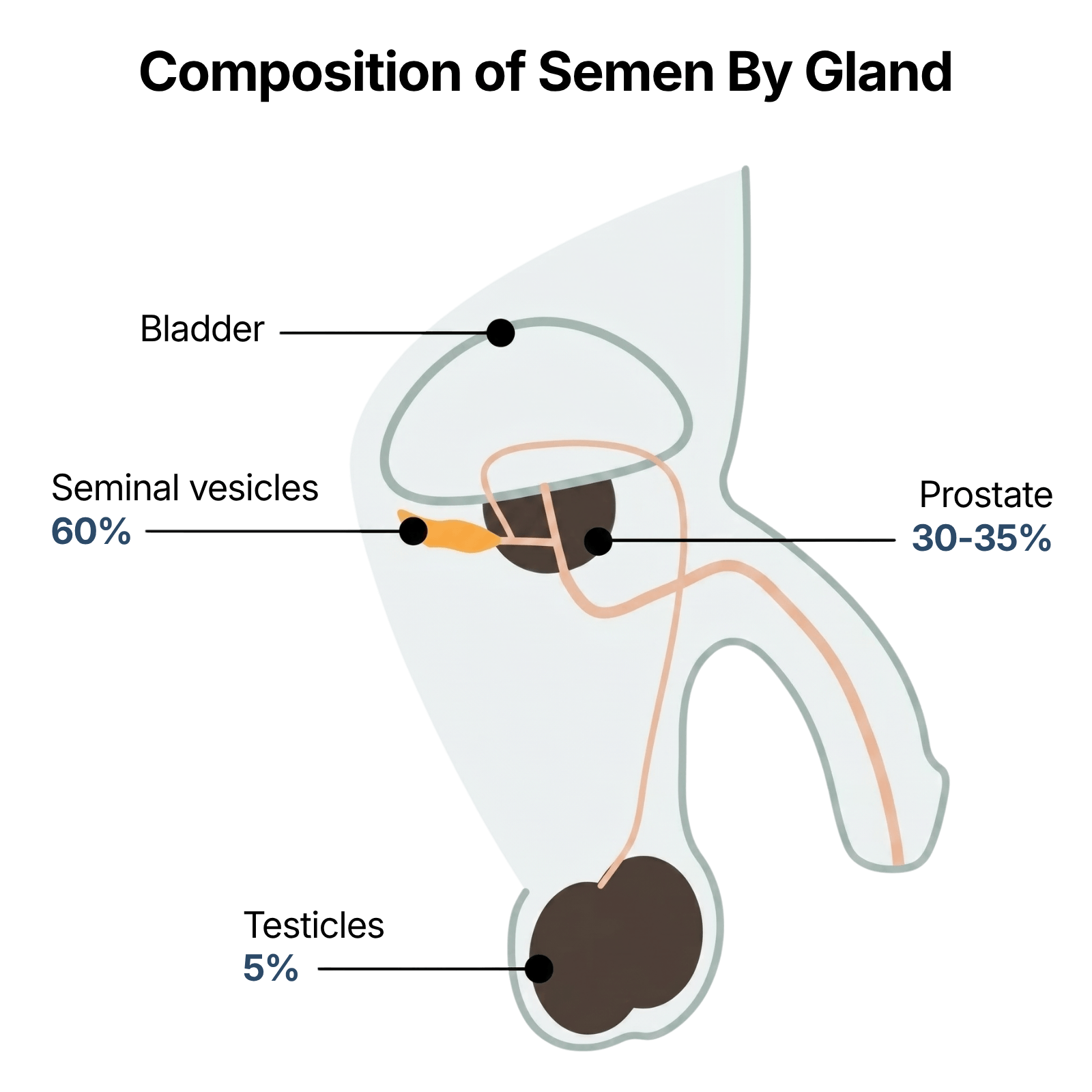
That distribution is the whole reason this matters. Volume is mostly fluid, and fluid production depends on three things handled at once: the raw material fluid is built from, the gland function that governs output, and the trace mineral the system is most dependent on.
One: the right inputs. Address one pathway and you've addressed a fraction of the system. The rest stays bottlenecked. All three have to be covered.
Two: the doses that were actually studied. Every ingredient with real evidence has a dose range that evidence came from. Below it, the ingredient is on the label but not in the amount shown to do anything. This is the single most common reason a man takes a supplement faithfully and feels nothing.
Three: the forms the body can absorb. A nutrient can come in a form that absorbs readily or one that largely passes through, and the absorbable form is almost always costlier to source. It never shows on the front of a label, but it decides whether the dose you paid for is the dose you receive.
Three inputs. Clinical doses. Absorbable forms. That's the standard. Everything below is us showing our work against it.
Sunflower Lecithin
1,200 mgWhat it does
Lecithin is a phospholipid — the raw material seminal fluid is built from. Your body makes it, but production declines with age and exposure; supplementing restocks the building-block supply.
Why this dose
1,200 mg is the level documented research and detailed user data converge on as the floor for a noticeable effect. We dose it there, not as a trace inclusion.
Why this form
Lecithin comes from two common sources, and the choice is deliberate. Soy is cheaper and more common, but carries lower bioavailability and a known concern around plant estrogens. Sunflower avoids both: cleaner, less prone to pesticide contamination, none of the estrogenic baggage. It costs more to source. We use it anyway, because the source is part of whether the ingredient does its job.
Pygeum Extract
200 mgWhat it does
Pygeum addresses a different pathway — gland function. Its active compounds support the prostate and Cowper's gland, the structures governing fluid output. Lecithin supplies the material. Pygeum supports the machinery that moves it.
Why this dose
200 mg sits squarely in the clinically studied range. Pygeum has a deep evidence base for prostate and urinary function: a Cochrane review of 18 randomized controlled trials, over 1,500 men. We didn't discover pygeum. We dosed it the way the research says to.
Why this form
This is where most pygeum quietly falls short. Pygeum's activity comes from its sterol content, and unless an extract is standardized to a stated sterol percentage, there's no knowing how much active compound is in it. Most isn't standardized at all. Ours is, to a defined total sterol percentage. That's the difference between an ingredient and a guess.
Zinc
50 mgWhat it does
Zinc is the trace mineral the male reproductive system depends on most. The prostate holds roughly three times more zinc than any other soft tissue in the body. In a controlled study, men in a zinc-depleted state showed a 32% drop in semen volume.
Why this dose
50 mg: one of the rare cases where clinical literature and fifteen years of independent user consensus point to the exact same number. Not the token 5 or 10 mg of a generic multivitamin. The dose the evidence supports.
Why this form
Zinc forms are not equal. Zinc oxide is the cheapest and most common, and among the least absorbable, meaning much of it never enters your system. We use a fully absorbable form. The label number is only real if your body can take it up.
That's the formula. Three pathways, each covered. Three doses, each set where the evidence sits. Three deliberate sourcing decisions, each made for absorption over cost. Nothing else, and that's not an omission.
Why the formula stops at three
It's fair to ask why the label is so short. The supplement aisle trains you to read a long ingredient list as a more serious product. In this category, it's usually the opposite.
Every ingredient competes for two fixed resources: space in the capsule and room in the price. A fifteen-ingredient formula has divided both fifteen ways, so most of those ingredients end up at a fraction of their studied dose, included to be printed on the label, not to do anything. The list looks impressive. The formula is spread too thin to work.
We went the other way on purpose: identify the three inputs that drive the system, and spend the entire formula dosing those three properly. Three isn't where we stopped short. It's where we stopped adding things that wouldn't have worked.
How it's made
- FDA-registered facility
- GMP-certified manufacturing
- Third-party tested for purity and potency
What that adds up to
The standard above is the reason for the result below. Holy Grail is the most customer-recommended formula in its category, with more than 100,000 men now using it. Among recent customers, 94.2% report a noticeable result.
It's produced in an FDA-registered, GMP-certified facility and third-party tested. The testing is how a sourcing decision becomes a fact you can rely on rather than a claim you have to trust.
None of that is why the formula works. It's the consequence of building it to the standard, and not cutting a corner after.
This is the formula built to that standard
Everything on this page is the reasoning behind one product. Holy Grail is Sunflower Lecithin at 1,200 mg, standardized Pygeum Extract at 200 mg, and fully absorbable Zinc at 50 mg: the three inputs, at the doses the evidence supports, in the forms the body can use. Two softgels a day. Three ingredients, fully disclosed, because a formula built on getting the doses right has no reason to hide them.
We built it because we went looking for it and couldn't find it done correctly. The right ideas were everywhere, but properly dosed and properly sourced, in one place, they weren't. So we made that version.
If the explanation on this page matched something you've noticed in yourself, the next step is simple: see the formula in full, the complete supplement facts, the dosing, and the options for getting started.
References
-
Levine, H., et al. (2023). Temporal trends in sperm count: a systematic review and meta-regression analysis of samples collected globally in the 20th and 21st centuries. Human Reproduction Update, 29(2), 157–176. pubmed.ncbi.nlm.nih.gov/36527838
-
Wilt, T., et al. (2002). Pygeum africanum for benign prostatic hyperplasia. Cochrane Database of Systematic Reviews, CD001044. pubmed.ncbi.nlm.nih.gov/11869585
-
Hunt, C.D., et al. (1992). Effects of dietary zinc depletion on seminal volume and zinc loss, serum testosterone concentrations, and sperm morphology in young men. Am J Clin Nutr, 56(1), 148–157. pubmed.ncbi.nlm.nih.gov/1609752
-
Mawson, C.A., & Fischer, M.I. (1952). The occurrence of zinc in the human prostate gland. Can J Med Sci, 30(4), 336–339.
-
Owen, D.H., & Katz, D.F. (2005). A review of the physical and chemical properties of human semen and the formulation of a semen simulant. J Androl, 26(4), 459–469. pubmed.ncbi.nlm.nih.gov/15955884